Relato Tutorial 4
Link para o Tutorial 4: Introduction to Linux kernel Character Device Drivers
Depois desse tutorial entendemos um pouco mais a frase “Tudo no Linux é um arquivo”, a final é nesse tutorial que aprendemos sobre os chamados Linux character devices, que são arquivos especiais utilizados para fazer a comunicação entre o espaço do usuário e o kernel. Também desenvolvemos o nosso primeiro driver para interagir com um desses “arquivos”.
Como nesse tutorial não tive nenhum problema para seguir os passos vou registar aqui tudo funcionando localmente.
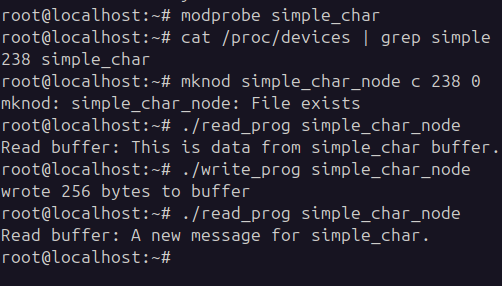
O driver desenvolvido, simple_char, não faz muito mais do que tranferir informações de texto entre o espaço do usuário e um buffer no espaço do sistema, através de um character device. Podemos testar isso com auxilio dos scripts fornecidos pelo tutorial read_prog e write_prog:
Proposed Exercices
-
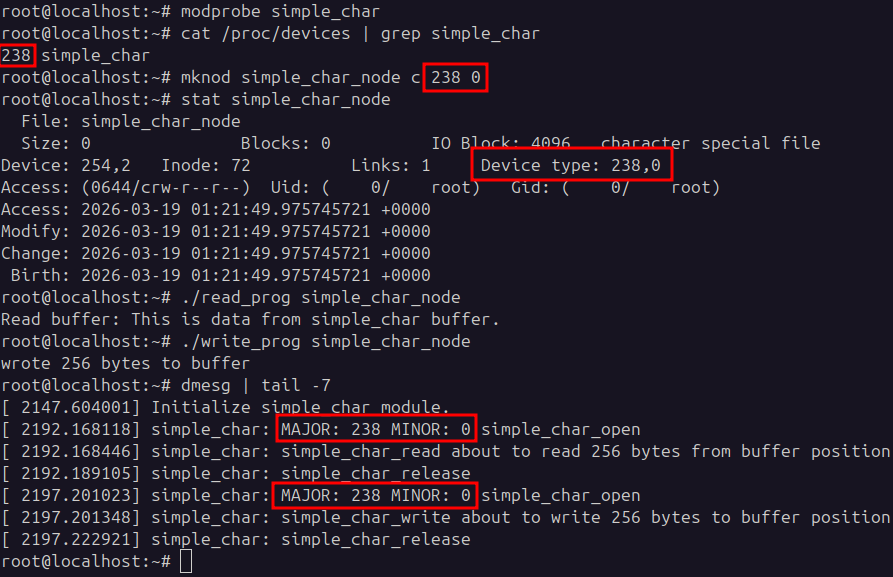
Printing device numbers: Modify the simple_char driver to make it print major and minor device numbers on device open.
After a little bit of research I found that the device numbers are stored in the inode structure, so I modified the
simple_char_openfunction to print the major and minor numbers from inode pointer using the functions MAJOR and MINOR. Here is the modified code:... static int simple_char_open(struct inode *inode, struct file *file) { int major_num = MAJOR(inode->i_rdev); int minor_num = MINOR(inode->i_rdev); pr_info("%s: MAJOR: %d MINOR: %d %s\n", KBUILD_MODNAME, major_num, minor_num, __func__); return 0; } ...After recompiling and installing the module, I ran the test scripts again and got the following output in the kernel log:
-
Device private data: Modify the simple_char driver to register more than one minor device number and make it keep separate buffers for each of them. Check the device minor number on device open and allocate a buffer for it if it doesn’t have one. Also, make the read/write operations run over the buffer for the particular major/minor device number pair. Access
f_inodefield ofstruct fileto get a pointer to the device inode then accessi_rdevfield ofstruct inodeto get the device ID (dev_t) from which you can extract the device minor number. On module unload, free all allocated buffers. With that, we can think of each pair of major/minor numbers as a different character device and each of them will have their own data. Finally, create device nodes with different minor numbers to test you implementation.This one was a little bit more tricky, but i managed to implement it by creating a array of buffers, one for each minor number. After modifing all the functions except simple_char_release, the code looks like this:
 #include <linux/init.h>
 #include <linux/module.h>

 #include <linux/kdev_t.h> /* for MAJOR */
 #include <linux/cdev.h> /* for cdev */
 #include <linux/fs.h> /* for chrdev functions */
 #include <linux/slab.h> /* for malloc */
 #include <linux/string.h> /* for strlen() */
 #include <linux/uaccess.h> /* copy_to_user() */

 struct cdev *s_cdev;
 static dev_t dev_id;

 #define S_BUFF_SIZE 4096

 #define MINOR_NUMS 2

 static char *s_bufs[MINOR_NUMS];

 static int simple_char_open(struct inode *inode, struct file *file)
 {
     int major_num = MAJOR(inode->i_rdev);
     int minor_num = MINOR(inode->i_rdev);
     pr_info("%s: MAJOR: %d MINOR: %d %s\n", KBUILD_MODNAME, major_num, minor_num, __func__);
     if (!s_bufs[minor_num]) {
         s_bufs[minor_num] = kmalloc(S_BUFF_SIZE, GFP_KERNEL);
         if (!s_bufs[minor_num])
             return -ENOMEM;

         snprintf(s_bufs[minor_num], S_BUFF_SIZE, "This is data from simple_char buffer. MAJOR: %d MINOR: %d", major_num, minor_num);
         pr_info("%s: MAJOR: %d MINOR: %d %s Allocated new buffer for minor %d\n", KBUILD_MODNAME, major_num, minor_num, __func__, minor_num);
     }
     return 0;
 }

 static ssize_t simple_char_read(struct file *file, char __user *buffer,
                 size_t count, loff_t *ppos)
 {
     int minor_num = MINOR(file->f_inode->i_rdev);
     int n_bytes;
     pr_info("%s: %s about to read %ld bytes from buffer position %lld\n",
         KBUILD_MODNAME, __func__, count, *ppos);
     n_bytes = count - copy_to_user(buffer, s_bufs[minor_num] + *ppos, count);
     *ppos += n_bytes;
     return n_bytes;
 }

 static ssize_t simple_char_write(struct file *file, const char __user *buffer,
                 size_t count, loff_t *ppos)
 {
     int minor_num = MINOR(file->f_inode->i_rdev);
     int n_bytes;
     pr_info("%s: %s about to write %ld bytes to buffer position %lld\n",
         KBUILD_MODNAME, __func__, count, *ppos);
     n_bytes = count - copy_from_user(s_bufs[minor_num] + *ppos, buffer, count);
     return n_bytes;
 }

 static int simple_char_release(struct inode *inode, struct file *file)
 {
     pr_info("%s: %s\n", KBUILD_MODNAME, __func__);
     return 0;
 }

 static const struct file_operations simple_char_fops = {
     .owner = THIS_MODULE,
     .open = simple_char_open,
     .release = simple_char_release,
     .read = simple_char_read,
     .write = simple_char_write,
 };

 static int __init simple_char_init(void)
 {
     int ret;

     pr_info("Initialize %s module.\n", KBUILD_MODNAME);

     /* Dynamically allocate character device device numbers. */
     /* The name passed here will appear in /proc/devices. */
     ret = alloc_chrdev_region(&dev_id, 0, MINOR_NUMS, "simple_char");
     if (ret < 0)
         return ret;

     /* Allocate and initialize the character device cdev structure */
     s_cdev = cdev_alloc();
     s_cdev->ops = &simple_char_fops;
     s_cdev->owner = simple_char_fops.owner;

     /* Adds a mapping for the device ID into the system. */
     return cdev_add(s_cdev, dev_id, MINOR_NUMS);
 }

 static void __exit simple_char_exit(void)
 {
     /*
     * Undoes the device ID mapping and frees cdev struct, removing the
     * character device from the system.
     */
     cdev_del(s_cdev);
     /* Unregisters (disassociate) the device numbers allocated. */
     unregister_chrdev_region(dev_id, MINOR_NUMS);

     for (int i = 0; i < MINOR_NUMS; i++) {
         if (s_bufs[i]) {
             kfree(s_bufs[i]);
             pr_info("%s: The buffer for minor %d is free\n", KBUILD_MODNAME, i);
         }
     }
     pr_info("%s exiting.\n", KBUILD_MODNAME);
 }

 module_init(simple_char_init);
 module_exit(simple_char_exit);

 MODULE_AUTHOR("felipers@ime.usp.br");
 MODULE_DESCRIPTION("A simple character device driver example.");
 MODULE_LICENSE("GPL");
Despite the new stuff, I also had to change
strcpytosnprintfin simple_char_open function, beacuse I wanted to print major and minor numbers on the buffer and strcpy doesn’t format the string: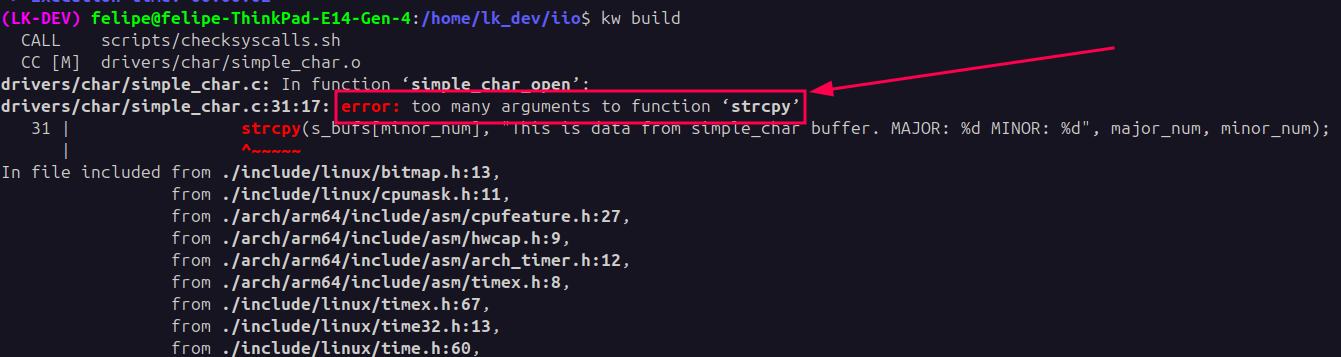
After recompiling and installing the module, I created two device nodes with different minor numbers to test the implementation: